A New Website!

On MattCHoward.com, I try to keep the content relevant to my academic work.  That is, most of the pages and posts are either (a) answers to student questions, (b) answers to statistical research questions, (c) or relevant to my current
studies.  I recently realized that MattCHoward.com has little room for content
regarding my consulting experiences.  For this reason, I started the website
StatisticalBullshit.com!

The purpose of StatisticalBullshit.com is to educate readers about
nefarious statistical practices commonly seen in industry – practices that could be costing you thousands…or even millions!  Most of the posts will discuss
business statistical issues, but many topics will also cross-over into research discussions.  For instance, the first post is about p-hacking, which can be used to advance an expensive consulting agenda or successfully publish lackluster
research findings.  So, it does not matter if you are currently in academia or
business, StatisticalBullshit.com should have enjoyable content for everyone.

Testing for Dual Mediation

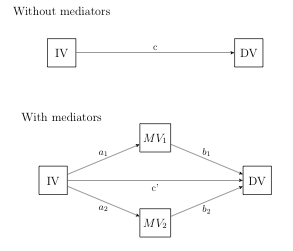
mediationRecently, I performed a study in which I needed to test for dual mediation – when the

indirect effect of Y on X goes through two mediators
(pictured here).  Whenever I need to test for mediation or moderation of any type, I first go to Hayes’s PROCESS macro for SPSS.  It is easy, and it adheres to most all
current best-practices.  If you don’t have it yet, I STRONGLY suggest that you download it now:  http://www.processmacro.org/index.html .  It has saved me hours (days?) on statistical analyses.

So, I opened up the documentation for PROCESS and I found…that it does not have a model for dual mediation!  Of all things, I would have assumed that PROCESS would be able to test for dual mediation!

I searched online for solutions, and I even referred to mediation textbooks to
devise a formula to test for dual mediation.  After having moderate success, I
finally went back to PROCESS.  Out of frustration, I set the program to test the traditional mediation model (with one mediator), but I included two mediators in the dialogue window.  And what did I see?  It provided output for dual mediation!

While this information may not be groundbreaking, it certainly helped me.  I hope that it can also help someone who is as frustrated with dual mediation as I was.  The permanent page for dual mediation testing can be found here:  Testing for Dual Mediation .

If you need any help running dual mediation in process (or any other statistical questions), feel free to email me at MHoward@SouthAlabama.edu.  I always
enjoy hearing from people running interesting statistics!

Commonly Used Survey Scales

It’s been awhile since I’ve made a blog post, but I am consistently updating my website.  So, I thought I’d make a quick post about the section that I update the most:  the List of Commonly Used Scales from the Statistical Help section of my website.

This page includes popular scales taken from academic articles.  Most of these prior articles have demonstrated sufficient psychometric properties and validity information regarding the scale, which means that most reviewers and
practitioners would probably be accepting of their use.

The link to the List of Commonly Used Scales can be found here:  https://mattchoward.com/list-of-scales/ .

If you have any questions about the application of these scales, feel free to email me at MHoward@SouthAlabama.edu.

Seven Things You Should Know about CMA (Comprehensive Meta-Analysis)

CMA PhotoHi All!

I just completed another page on my Statistics Help section of MattCHoward.com!  The new page
reviews seven things that I wish I knew about CMA (Comprehensive Meta- Analysis) before purchasing the program.  Overall, CMA is very good, but there are certain missing key features.  So, before buying the program, I highly suggest that potential users should read my new Statistics Help page entitled,
Seven Things You Should Know about CMA (Comprehensive Meta-Analysis).

As always, please contact me (Matt Howard) at mch248@psu.edu if you have any statistics or research questions, and please let me know if you would like a page created about a particular statistical method.  Thanks for reading!

Writing Items for a Scale

stock photoEver need to make a scale or survey for work or research?  I just uploaded a page on my Statistics Help portion of my website which gives an overview of the item writing process.  This includes a step-by-step process and common mistakes.  A must-read if you ever need to make a scale or a survey!

Click here to learn about writing items for a scale!

Also, click here for more statistics help!

New Stats Help Page on Item-Sort Tasks

BusinessAndPsychologyIn light of my fairly recent article in the Journal of Business and Psychology, I thought I’d write a brief summary on item-sort tasks.  So, now on the “Stats Help” portion of my website, a guide presents the logic, method, and statistics of item-sort tasks.

In short, the guide explains (a) when to use item-sort tasks and (b) how to perform an item-sort task, and (c) how to analyze an item-sort task.  After reading the guide, most anyone should be able to perform an item-sort task them-self.

As always, if you want to know more about statistics or item-sort tasks, please email me at mch248@psu.edu!  I’m always happy to chat!

2015 SIOP Conference

SIOP2015Hi all!

I’ll be at the 2015 SIOP conference this week in Philadelphia to present two posters.  The first poster is on Friday at 10:30, and it is entitled “The Importance of Person-Specific Approaches in Expatriate Research.”  It notes the necessity to understand the person and person-specific processes when analyzing longitudinal changes in expatriates, which is often a focus of research and practice.  The second poster is also on Friday at 3:30, and it is entitled “Are Head-Mounted
Virtual Reality Systems Useful for Training and Education?”  The study analyzes the confusing outcomes when HMVRSs are used for training purposes.  Both of them will be in Franklin Hall.  If you are at the conference, come by and check them out!

New Stats Help Page on Serial Mediation / Sequential Mediation

SerialMediationHi all!

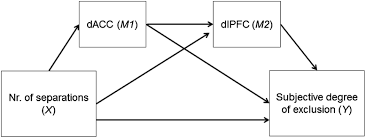
I just uploaded a new page on the “Stats Help” portion of my website.  The link is here: Sobel Test Formula for Serial Mediation / Sequential Mediation .

In short, I spent much too long finding the sobel test formula for the indirect effect of X on Y through M1 and M2 in a serial mediation / sequential mediation.  To prevent this from happening to other researchers (and possibly myself again), I provide a brief summary of mediation, sobel tests, and serial mediation / sequential mediation.  Then, I provide the relevant sobel test formula.

If you want to know more about serial mediation / sequential mediation, please contact me at mch248@psu.edu.  I’m always happy to chat about stats!

Two New Stats Help Pages! Both on p-Values

jacob-cohenToday, I uploaded two new pages to the “Statistics Help” tab on my website.
They are:

The Meaning of p-Values: A Guide for Social and Organizational Science
Students & Researchers

The p-Value Controversy: A Guide for Social and Organizational Science Students &
Researchers

As apparent from the titles, both pages focus on p-values.  Whenever I teach a class, about statistics or otherwise, students seem to only care about p-values when understanding studies’ results.  Unfortunately, much is still unknown if only
p-values are interpreted.  The first page provides an overview into the theory, logic, and calculation of p-values.  The second page reviews the controversy of p-values – one that is still ongoing today.

If you are still confused about p-values after reading these two pages, please email me at mch248@psu.edu.  We can chat, and I can figure out additions to the pages to clarify the concepts.

Study on Hiatus 1 – Expatriate Online Groups

ExpatPicEvery researcher has confidently started a study with
assurances of it being a top-tier publication, just to have it fizzle out into only a conference presentation.  Sometimes the theory doesn’t hold up across multiple
studies.  Other times, the coauthors don’t follow-through on their end of the bargain.  Often, like in the subject of this blog post, the sample never comes through.

Sometime in 2013, I started a study which focused on expatriates’ use of online groups.  I believe that expensive organizational interventions to ease expatriate adjustment are less effective than cheaper alternatives.  In fact, I think one of the best alternatives may be free – online groups.  Online groups are collections of individuals who perceive a common identity and largely interact through computer-mediated-communications.  Currently, hundreds-of-thousands (if not millions) of online groups exist for an array of purposes.  The purpose of a small portion of these is to connect expatriates with common characteristics, such as home and host country.  I believe that individuals who use these online groups before and during their expatriate experiences experience less uncertainty, more positive emotions, and better expatriate outcomes.

To investigate this notion, I performed an initial qualitative study.  Using two expatriate forums, I administered an open-ended questionnaire.  Within a day I received about thirty responses, and the data was fantastic.  Several respondents completed paragraphs of text about their expatriate experiences and the role that the online group played.  Enthusiastic about the initial success, I created a quantitative survey to administer to other expatriate online groups.  The final goal was to write an article with Study 1 as the qualitative results and Study 2 as the quantitative results.

I posted the survey on a number of expatriate forums.  Then I waited…and waited…and waited.  I received about three responses in 30 days.  I’m not exactly sure why the latter forums were resistant to completing the survey.  Maybe they didn’t want to fill-in bubbles, and would rather type their responses.  Maybe they were suspicious of the survey in general.  Regardless, some of my other studies around this time were more successful, and the expatriate online group study was placed on the back-burner.

Just to get something from my time, I presented a poster of the qualitative data at APA in 2014.  The paid (by my department) trip to DC was nice, but I would have much rather gotten a JAP or AMJ publication from my time.  But nevertheless, here is the poster if anyone is curious of the results: APA 2014 Expat Poster .  If anyone ever wants to rekindle the study, I would be happy to collaborate.  It wouldn’t be an overly difficult process, as the theory is largely straightforward.  But until then, this study remains on hiatus.