
New post on StatisticalBullshit.com! This post discusses how outliers can skew your results…and how sometimes removing outliers can also skew your results! To read more about Statistical Bullshit, use the following link: https://statisticalbullshit.com/2017/10/09/bullshit-outliers/ .
Tag Archives: Work
Identifying Multiple Modes in Excel
Very early in my intro-level statistics courses, I always cover the topics of mean, median, and mode. For any dataset, there can only be a single mean and/or median value, but there can be multiple modes. For some strange reason, the =mode() command in Excel will only provide the first mode that appears in a dataset, even when multiple modes exist! For this reason, I made a guide on how to use the =mode.mult() command. Never again should you incorrectly identify the number of modes in a dataset!
Here is the link: https://mattchoward.com/multiple-modes-in-excel/
Descriptive Statistics in Excel
I just added a page on How to Calculate Descriptive Statistics in Excel to the Excel Statistics Help portion of my Statistics Help page. If you need help calculating descriptives, click here:
https://mattchoward.com/descriptive-statistics-in-excel/
As always, email me at MHoward@SouthAlabama.edu if you have any questions!
How to Perform a T-Test in Excel
Recently, I added a page on How to Perform a T-Test in Excel to the Excel Statistics Help portion of my Statistics Help page. So, if you need help performing a t-test in excel, click here:
https://mattchoward.com/how-to-perform-a-t-test-in-excel/
As always, email me at MHoward@SouthAlabama.edu if you have any questions!
New Page on the Perils of Small Samples
On StatisticalBullshit.com, I recently posted a new page on the perils of small sample sizes. Some quick examples show that small samples may bias your results in unexpected ways. So be sure to read it here: https://statisticalbullshit.com/2017/08/07/small-samples-big-problems/ .
As always, if you have any statistical questions or comments, please email me at MHoward@SouthAlabama.edu!
Activating “Data Analysis” in Excel
Have you ever wanted to calculate a simple statistic in Excel, but couldn’t find the correct tab to do so? If so, it is possible that you did not have the “Data Analysis” tab activated. For some reason, Excel defaults the Data Analysis tab as
inactivate, although it is completely free and per-installed. Weird, right!?
As always, if you have any questions, comments, or requests, please email me at MHoward@SouthAlabama.edu!
What is in a Mean?
New post on StatisticalBullshit.com! This post discusses when mean comparisons are appropriate. Perhaps more importantly, this post also discusses when mean comparisons are inappropriate. Particularly, it focuses on a prior personal experience of mine, in which a manager believed that the means of two variables could provide information regarding their linear relationship. If you believe that you, your boss, or anyone else has made this mistake in the past, be sure to read the post to understand how to avoid Statistical Bullshit in the future! Also, feel free to email me (MHoward@SouthAlabama.edu) any questions or future posts that you’d like to see on StatisticalBullshit.com.
The link to the post is here: https://statisticalbullshit.com/2017/07/31/what-is-in-a-mean/ .
A New Website!
On MattCHoward.com, I try to keep the content relevant to my academic work. That is, most of the pages and posts are either (a) answers to student questions, (b) answers to statistical research questions, (c) or relevant to my current
studies. I recently realized that MattCHoward.com has little room for content
regarding my consulting experiences. For this reason, I started the website
StatisticalBullshit.com!
The purpose of StatisticalBullshit.com is to educate readers about
nefarious statistical practices commonly seen in industry – practices that could be costing you thousands…or even millions! Most of the posts will discuss
business statistical issues, but many topics will also cross-over into research discussions. For instance, the first post is about p-hacking, which can be used to advance an expensive consulting agenda or successfully publish lackluster
research findings. So, it does not matter if you are currently in academia or
business, StatisticalBullshit.com should have enjoyable content for everyone.
Testing for Dual Mediation
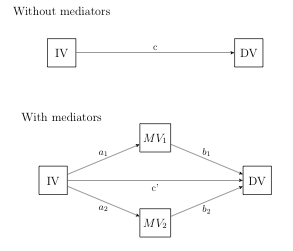 Recently, I performed a study in which I needed to test for dual mediation – when the
indirect effect of Y on X goes through two mediators
(pictured here). Whenever I need to test for mediation or moderation of any type, I first go to Hayes’s PROCESS macro for SPSS. It is easy, and it adheres to most all
current best-practices. If you don’t have it yet, I STRONGLY suggest that you download it now: http://www.processmacro.org/index.html . It has saved me hours (days?) on statistical analyses.
So, I opened up the documentation for PROCESS and I found…that it does not have a model for dual mediation! Of all things, I would have assumed that PROCESS would be able to test for dual mediation!
I searched online for solutions, and I even referred to mediation textbooks to
devise a formula to test for dual mediation. After having moderate success, I
finally went back to PROCESS. Out of frustration, I set the program to test the traditional mediation model (with one mediator), but I included two mediators in the dialogue window. And what did I see? It provided output for dual mediation!
While this information may not be groundbreaking, it certainly helped me. I hope that it can also help someone who is as frustrated with dual mediation as I was. The permanent page for dual mediation testing can be found here: Testing for Dual Mediation .
If you need any help running dual mediation in process (or any other statistical questions), feel free to email me at MHoward@SouthAlabama.edu. I always
enjoy hearing from people running interesting statistics!
Seven Things You Should Know about CMA (Comprehensive Meta-Analysis)
 Hi All!
I just completed another page on my Statistics Help section of MattCHoward.com! The new page
reviews seven things that I wish I knew about CMA (Comprehensive Meta- Analysis) before purchasing the program. Overall, CMA is very good, but there are certain missing key features. So, before buying the program, I highly suggest that potential users should read my new Statistics Help page entitled,
Seven Things You Should Know about CMA (Comprehensive Meta-Analysis).
As always, please contact me (Matt Howard) at mch248@psu.edu if you have any statistics or research questions, and please let me know if you would like a page created about a particular statistical method. Thanks for reading!
 Dr. Matt C. Howard